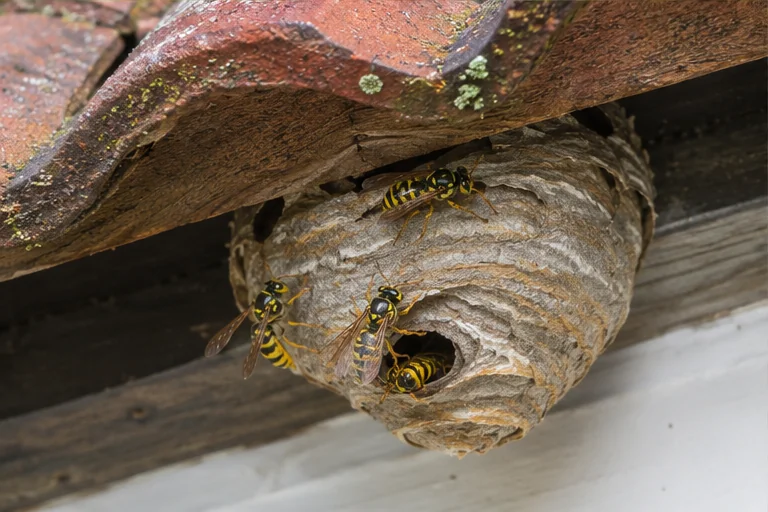
Wasps commonly establish seasonal nests in roof voids, wall cavities, sheds, under eaves or underground. Repeated traffic through one opening may indicate a nest, but wasps feeding in a garden do not necessarily mean a nest is on the property.
Spot the evidence
Signs to look for
These signs can indicate a problem, but not every sign is conclusive. A proper identification helps determine the next step.
- Wasps regularly entering and leaving the same gap.
- A visible grey, layered paper nest in a sheltered location.
- Increased wasp traffic close to doors, roofs or outbuildings.
- Activity from ground-level holes or other concealed entry points.
A measured response
How professional control is approached
Where appropriate, a technician selects an approved approach suited to the nest and access conditions. The nest may not be physically removed, particularly inside cavities. We explain any temporary exclusion area and when it is sensible to reassess activity.
Before treatment
What an assessment involves
We ask about the nest location, access, height, proximity to people and any safety concerns. Correct identification matters: bees and wasps are different, and an inactive old nest may need no insecticidal treatment.
Reduce recurrence
Practical prevention
- Keep outdoor bins closed and clear up food and sweet-drink spills.
- Inspect accessible eaves and sheds for new activity in spring.
- Avoid blocking the entrance to an active hidden nest.
- Do not attempt to disturb a nest in a confined or elevated location.
Common questions
Wasp Nest Removal FAQs
Do you remove the nest itself?
Physical removal is not always possible or required. Treatment and removal depend on its location and the site assessment.
Is a wasp nest used again next year?
Most common social wasp colonies are annual; new queens generally establish new nests in later seasons.
Do you treat bees?
We do not automatically treat bees as wasps. Identification and appropriate advice come first.
Need an assessment?
Tell us what you have noticed.
Describe the activity and location so we can advise on the next practical step.